
Overexertion injuries, the kind that come from pulling, pushing, and lifting, are one of the leading causes of injuries in the workplace.
Our industry, transportation and warehousing, leads the pack in musculoskeletal injuries.
That is why there is a focus on heavy to light items during slotting maintenance. Not only across your entire pick path on a large scale, but also in each individual bay of slots. Weight distribution is also important in the overhead racking.
Overhead/Reserve Racking
In the overhead racking, you want the pallets of heavier items closer to the floor. Keeping the center of gravity as low as possible in the racking makes for a more stable rack and an overall safer workplace.
Fun industry fact: when you see those rows and rows of aisles in a warehouse, with the blue upright racks. Those racks are sometimes only held to the floor with 1 or 2 bolts per foot, so 2 or 4 per blue upright.
Working towards that overall operational goal, try to store the bulk of your heavier items closer to the floor.
Pick Path Heavy to Light
I worked in a large distribution center, with anything a restaurant could need on a weekly basis. The best way to see heavy-to-light in action is to walk a real pick path. Here’s what it looked like in mine.
In the freezer, we started our pick path with up to 80 pound boxes of frozen meat, and up to 40 pound boxes of french fries. In the middle were the 20-30 pound boxes of frozen vegetables, and the 10-20 pound boxes of various frozen goods sprinkled throughout. At the end we had huge boxes of frozen bread and pastries.
In our cooler, we also started with up to 80 pound boxes of meat, then we had 5 gallon buckets, 4-1 gallon boxes of salad dressings. Ending with 5 pound boxes of meat and 8 ounce boxes of herbs and spices.
In our dry area, we started off with our 6-1 gallon cases of bleach. This was selected first, so that if it leaked, it couldn’t damage or cross contaminate other products easily being on the bottom of the pallet. Earlier in the pick path we had 35# oil containers, 50 pound bags of flour. We had cases of 6-10’s and 4-1 gallon jugs all throughout. In the middle were cases of coffee, crackers and herbal teas. We ended our dry selection with cases of potato chips and foam cups and plates.
Slotting Special Note: Regarding cases of 6-10 cans and 4-1 gallon boxes. These are heavy cases, and they easily average over 50 pounds each. Given that weight, they can realistically only be placed in floor locations. Reaching up to grab these cases off of higher locations could be unsafe. Since they should be placed on the floor, they easily spread through the first 75 % of my pick path. The selectors and supervisors would send me move requests “6-10’s in slot so-and-so, move earlier in path”. My response became a generic reply: “Where?, find any location it would be better in earlier in the path, and let me know. There are none that I can find.” I told my boss the same thing, when he would bring it up. You can only do what you can do, but you have to be able to prove you tried.
Organizing the pick path from heavy to light is not that difficult to accomplish. All it takes is attention to detail and a consistent time commitment. This time can be spent walking the aisles, looking for items out of place, or analyzing reports.
Power Zone Heavy to Light
Now let’s look at what heavy to light means on the individual bay level. Before we do, you need to understand the power zone. From a safe lifting perspective in a warehousing environment, this power zone is the area close to your body, from mid thigh to mid chest. You want to do as much lifting as possible in this power zone.
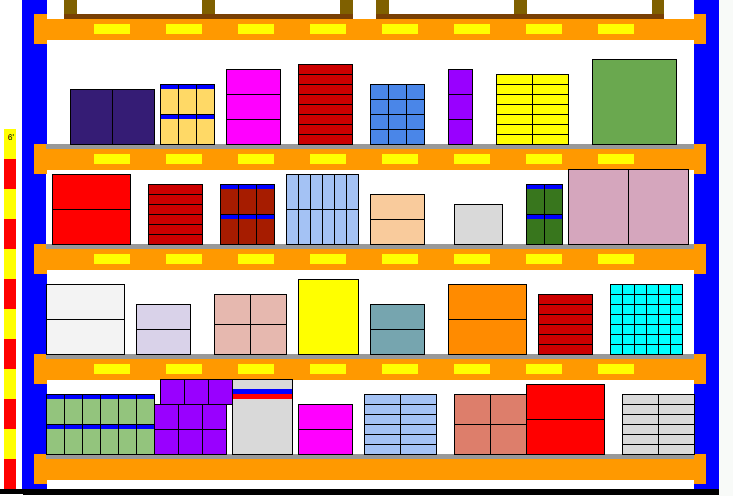
In this bay we have 4 different row heights of pick slots. With pick slots of this size, these are going to be smaller and/or slower moving items. Looking at this bay, we want to have the heaviest items on the second and third level of these slots. That means the selector will be pulling the heaviest cases in this bay from within their power zone. In addition to weight, we want to have the slowest moving items on the top and bottom layer in this bay. The reason for that is the risk of injury increases when working outside the power zone. You want the items outside the power zone to be the lightest and slowest moving items you have. While you want your heavier and faster moving items right in the zone, where they are best located for the selectors.
Finally….
Getting your pick path organized from heavy to light may seem like an overwhelming task. It isn’t. Walk your pick path with a set of fresh eyes, yours or someone elses’. Start from the end of your path, making a list of anything over “X” pounds (you decide where to start). Then walk from the start of your path looking for light items to swap them with. When checking for heavy/light cases outside the safe lifting power zone, just check a few bays at a time, if that’s what you can complete daily. Use any reporting you have available and maybe you can filter those results to find a lot of possibilities to move before walking the aisles and verifying your progress. The biggest hack to getting your pick line set is to be consistent in your moves daily or weekly.
The benefits gained from setting your pick line from heavy to light items are more operational in nature. Heavy items selected first means better built pallets, which means less potential damage during transit and happier customers. Your selectors will appreciate the pallets that practically build themselves and need less shrink wrap as they travel through the warehouse.
The benefits of adjusting your layout and optimizing the power zone for lifting and frequency of picks is creating a safer work environment. By optimizing the power zone, you are reducing the potential for injuries to the workers who are lifting those cases all day.
This National Safety Council’s Injury Facts page shows there are more than 674 injuries a day due to “Overexertion, repetitive motion, and bodily conditions”. That number is directly impacted by keeping heavy items where they should be. One of the most important aspects of the slotting coordinator’s job is to monitor the placement of heavy to light items to help reduce injuries and create a safer workplace.